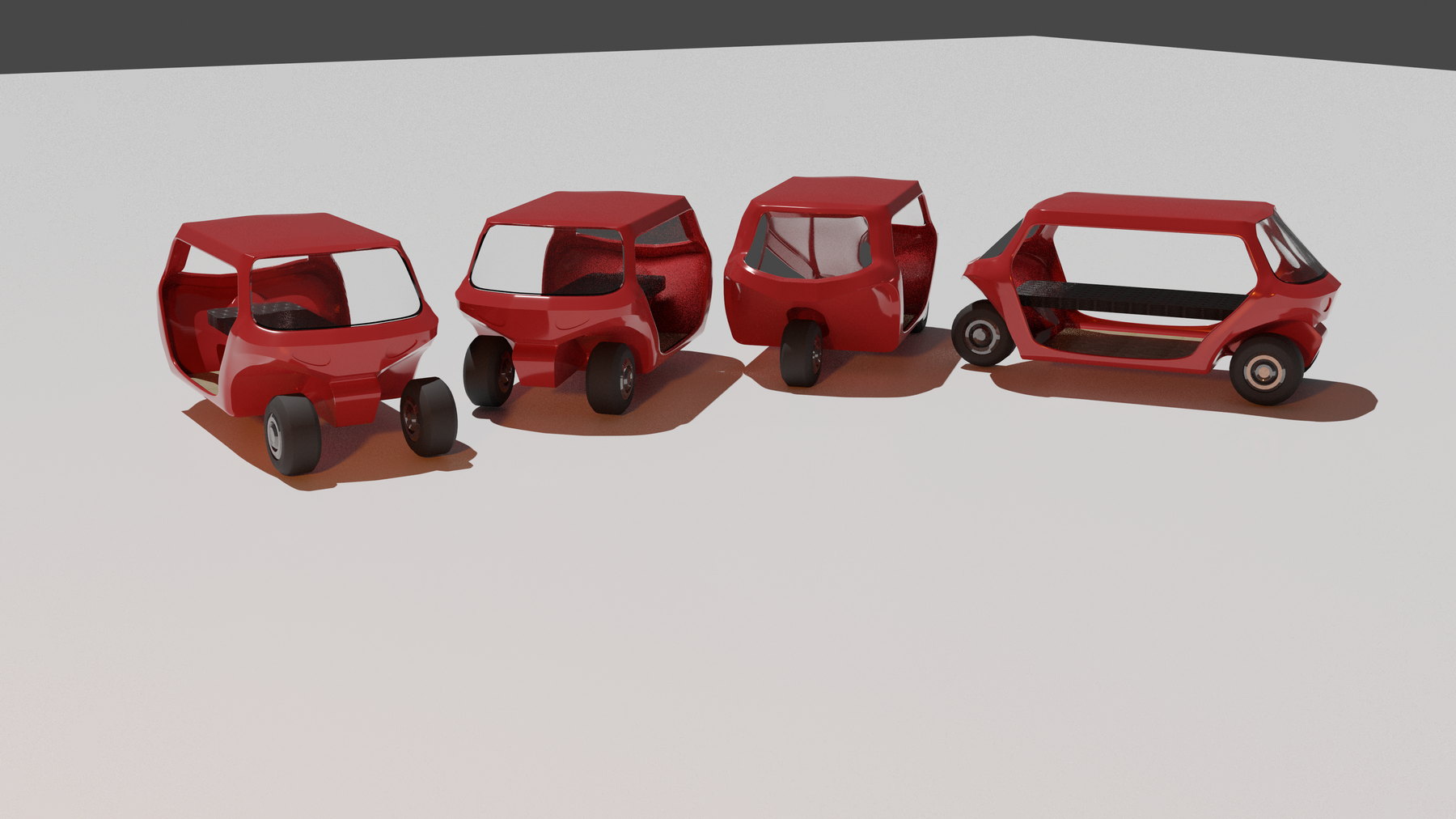
Take the auto-rickshaw — the most common vehicle on an Indian city street and one almost nobody has redrawn — and model a family of bodies on a shared floorpan: an enclosed cab, a longer passenger version, a squared-off utility and an open flatbed.
Why it seemed promising
Designing four at once forces the question of what is actually shared. Lay them in a row and the compromises become visible: the roofline that works on the passenger version makes the flatbed look unfinished, and you cannot argue your way out of it because both are in the same picture.
What was actually built
A 3D model and renders of the four variants, plus a reference moodboard that is not published here because it is other people's photographs.
Why it stopped or changed direction
Nothing stopped it so much as nothing continued it. It was a form exercise with no engineering behind it — no packaging study, no chassis, no regulation, no cost. As a drawing it is finished; as a vehicle it is barely a sketch.
What survived
Designing variants as a set rather than in sequence. It is the cheapest way to find out which decisions are structural and which are taste, and it is now how I start most form work.